Shred the Slopes

Liam Reilly
| 15-04-2026
 · Sport Team
There is nothing quite like the feeling of strapping into a snowboard for the first time.
The crisp air fills your lungs, the sun glints off the fresh powder, and you feel a surge of adrenaline as you look down the beginner slope.
Then, reality hits. You catch an edge, tumble awkwardly, and spend the next ten minutes trying to stand back up, wondering why anyone does this for fun. Snowboarding has a notoriously steep learning curve, but once you move past the initial bruising phase, it becomes an addictive dance with gravity. The secret isn't brute force; it is an understanding of balance, edge control, and the willingness to commit to the fall before you can learn to fly.
Finding Your Athletic Stance
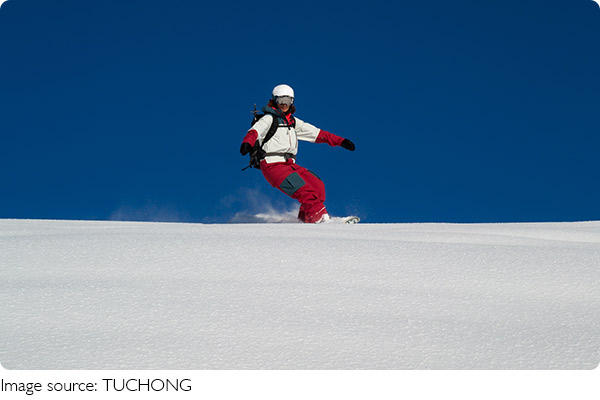
The foundation of all successful snowboarding is your basic stance. Forget standing up straight; you need to be in a dynamic, ready position. Your knees should be significantly bent—think of a moderate squat—and your weight should be centered over both feet. Your upper body needs to remain loose and aligned with the board, with your shoulders stacked directly over your hips.
Many beginners make the mistake of leaning back in fear, which actually lifts the front edge and makes the board uncontrollable. By keeping your weight centered or slightly forward, you allow the sidecut of the snowboard to do its job, engaging the snow and giving you the stability needed to initiate a turn. Think of your body as a shock absorber, ready to react to every bump and change in the terrain.
The Art of Falling and Getting Up
Before you learn to carve like a pro, you must master the art of falling without injury. Catching an "unintentional edge" is the most common cause of spectacular tumbles, usually happening when the downhill edge digs into the snow unexpectedly.
When you feel a fall coming, resist the urge to stick your arms out to break your impact, as this is a recipe for wrist injury. Instead, tuck your chin, make fists, and try to roll with the momentum. To get back up, use these steps:
1. Roll onto your stomach so you are facing uphill. 2. Dig your toeside edge (the one under your toes) firmly into the snow to create a stable anchor. 3. Push yourself up onto your knees, then gradually stand up, keeping your knees bent and using your core for balance.
Mastering Edge Control and "Garlands"
Snowboarding is all about managing the two steel edges running along the sides of your board. To move across the slope, you initiate a "sideslip" on either your heel or toe edge, controlling your speed by applying pressure. Once comfortable slipping, you can practice "Garlands."
A Garland is a single, shallow turn where you point the nose of the board downhill, engage an edge to make a slight arc, and then bring the board back across the hill to a stop. This drills the muscle memory needed to transition from one edge to the other without catching that dreaded downhill side. Mastering this controlled engagement is the gateway to linking turns.
The Commitment of Initiating Turns
The biggest mental hurdle is the "J-turn," where you commit to pointing the board directly down the fall line before initiating the edge change. As you gain speed, your brain screams "brake!", but to turn, you must briefly accelerate.
To turn from your heelside to your toeside, start with your knees bent and weight forward. Gently shift your weight toward the nose, allowing the board to point downhill. Then, smoothly roll your ankles forward, applying pressure to your toes and "driving" your front knee over the toeside edge. Your upper body should follow your hips, rotating in the direction you want to go. The board will naturally follow the arc. This requires trust—trust in your stance and trust that gravity is your partner, not your enemy.
Snowboarding is a sport that demands humility. It forces you to embrace failure on a very public stage, reminding us that progress is rarely a straight line. Every expert you see gracefully carving through powder once spent hours face-down in the snow, wondering if they would ever get the hang of it. The resilience you build on the mountain, the ability to get up after a painful fall and try again, is perhaps the greatest lesson of all. It is not about avoiding the tumble; it is about knowing that the rush of the perfect turn is worth every bruise it takes to get there.