Ants Speak in Scent

Arvind Singh
| 11-05-2026
 · Animal Team
Notice how a single ant finding food on a kitchen counter somehow results in a whole trail of them arriving within hours?
That's not coincidence, and it's not random wandering. It's a chemical messaging system so precise that it can coordinate the behavior of hundreds of thousands of individuals without a single spoken signal.
Ants are, in many ways, among the most accomplished communicators in the animal kingdom — they just do it entirely through smell.
The core of ant communication is pheromones: chemical compounds secreted from glands throughout the body, released into the environment, and detected by other ants through their antennae. Most species use somewhere between 10 and 20 distinct pheromone signals, each carrying a specific general meaning — things like "food here," "danger," "follow this trail," "this is a nest-mate, not an intruder."
It's a limited vocabulary compared to human language, but it's remarkably effective for the social tasks ants need to manage.
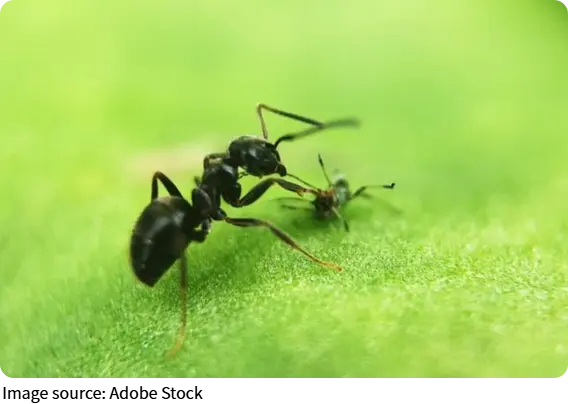
Trail Pheromones: The Invisible Road Network
When a foraging ant finds food, she doesn't just head back. She lays down a chemical trail — depositing pheromone molecules from glands in her abdomen along the route back to the nest. Other ants picking up this signal follow the trail, and as more ants travel the same path and reinforce it with their own secretions, the trail gets stronger, and more ants are recruited.
What makes this especially clever is how self-regulating it is. If a food source runs out, ants returning empty-handed simply stop reinforcing the trail. The pheromone evaporates, the signal fades, and recruitment drops off naturally — no central authority needed.
Research into Pharaoh's ants has shown that many species actually use multiple trail pheromones rather than just one, allowing them to encode not just direction but also information about trail quality, freshness, and whether a path is still worth following. This layered signaling gives foraging networks a kind of short-term memory — a record of which routes were recently productive.
Alarm Pheromones and the Panic Response
When an ant senses danger, the chemical response is immediate and dramatic. Alarm pheromones diffuse rapidly outward from the source, triggering a cascade of reactions in nearby nest-mates. The sequence unfolds in stages: nearby ants first become alert and start moving their antennae; then they begin actively searching; then they converge on the source; and finally, in many species, they shift into an aggressive posture.
Research published in the journal Cell documented this process in detail, using a fluorescent protein that lights up with brain activity to track what happens neurologically when ants detect alarm signals.
What the researchers found was striking: rather than the alarm pheromone activating broad areas of the brain the way other stimuli typically do, it lit up a very specific and small processing hub — a dedicated structure for threat response that appears to be more specialized than what's found in other social insects like honeybees.
Essentially, ants seem to have evolved a concentrated alarm-processing center that allows rapid, coordinated responses from minimal neural real estate.
The scale of that response depends on the colony. Smaller colonies tend toward panic and evacuation — flee, grab the larvae, get out. Larger colonies like driver ants, with hundreds of thousands of individuals, can afford to respond more aggressively, sending defenders toward the threat rather than simply running from it.
Beyond Pheromones: Chemical Identity and Colony Control
Pheromones do more than direct traffic and trigger alarms. They're also the mechanism by which ant colonies maintain social order at a deeper level. Each ant carries a chemical signature — a blend of compounds on its body surface that identifies it as a member of a specific nest.
Any ant that smells different gets treated as an outsider, often aggressively. This chemical identity system is what allows colonies to function as cohesive units despite having no central coordinator and thousands of interacting individuals.
Queen pheromones add another layer of control. Chemical signals from the queen suppress reproductive behavior in worker ants, preventing them from laying their own eggs. They also influence larval development, regulating how many individuals develop into queens versus workers or defenders— essentially shaping the colony's demographics through chemistry.
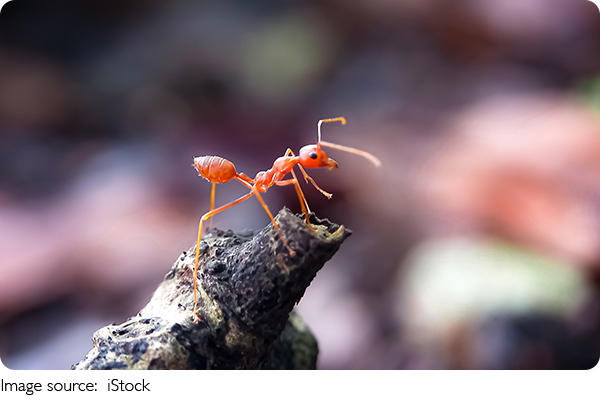
Ants also exchange chemicals more directly. Two ants touching mouthparts — what looks from the outside like a "kiss" — involves passing liquids from one ant's crop to another. This liquid contains chemical information about the colony's current needs and the role the receiving ant should be taking on. It's a form of direct, personalized messaging layered on top of the broader broadcast system of environmental pheromones.
The whole system — trails, alarms, identity markers, queen signals, direct transfers — adds up to something genuinely complex, operating entirely without language, sound, or central coordination.